
View Project
IOT Smart Energy Grid
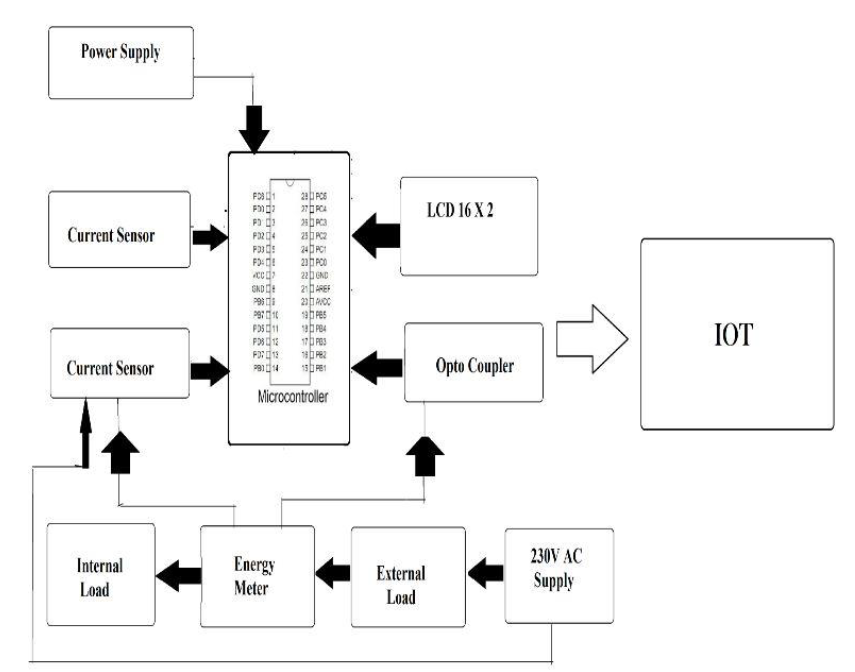
Components:
Hardware Components:
- ATmega328P AVR M icrocontroller
- ESP8266 Wi Fi Module
- Optocoupler
- Energy Meter
- Current Sensor
- LCD Displays
- Push Buttons
- LEDs, Resistors, Capacitors, Diodes
- Transistors
- Crystal Oscillator
- PCB, Cables, ConnectorsPCB, Cables, Connectors
- Transformer / AdapterTransformer / Adapter
- Load (Lamps)Load (Lamps)
Software Components:
- IoTGecko (Web Interface)IoTGecko (Web Interface)
- Arduino IDE / CompilerArduino IDE / Compiler
- Programming Language: Embedded CProgramming Language: Embedded C
Project Description:
An IoT-based Smart Energy Grid is an advanced electricity management system that integrates Internet of Things (IoT) technology, smart sensors, communication networks, and intelligent control systems to efficiently generate, transmit, distribute, and consume electrical energy. Unlike traditional power grids, which operate in a one-way flow of electricity, the smart energy grid enables two-way communication between utility providers and consumers, allowing real-time monitoring, automation, and optimized energy usage.The system consists of multiple interconnected components such as smart meters, voltage and current sensors, power quality monitoring units, renewable energy sources, energy storage systems, and intelligent controllers. These components continuously collect data related to power generation, consumption patterns, load demand, grid frequency, voltage levels, and fault conditions. Using IoT communication protocols such as Wi-Fi, GSM, LoRaWAN, Zigbee, or MQTT, this data is transmitted securely to a centralized cloud server or energy management platform for processing and analysis.One of the key features of the IoT Smart Energy Grid is real-time energy monitoring and analytics. Smart meters installed at consumer premises measure energy consumption at fine time intervals and send usage data to the utility provider. This enables accurate billing, demand forecasting, and detection of power theft or abnormal usage. Consumers can access this data through web dashboards or mobile applications, empowering them to monitor their energy consumption, reduce wastage, and adopt energy-efficient practices.The smart grid also supports the integration of renewable energy sources such as solar panels and wind turbines. IoT-enabled controllers monitor power generation from these sources and manage their synchronization with the main grid. Energy storage systems, including batteries, are intelligently controlled to store excess energy during low-dem

Accelerate innovation with world-class tech teams We’ll match you to an entire remote team of incredible freelance talent.