
View Project
IOT Weather Reporting System
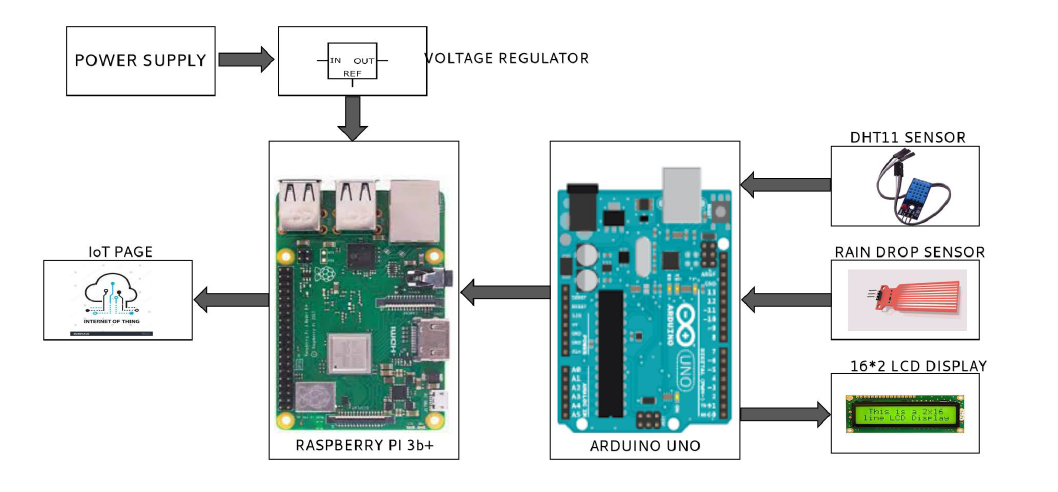

Components:
Components
Hardware:
- Arduino Uno
- Raspberry Pi
- Temperature and Humidity Sensor (DHT11)
- Rain Sensor
- 16x2 LCD Display
- Voltage regulator circuit
- PCB board
- Switches, LEDs, Resistors, Capacitors, Transistors
- Connecting wir es, cables, and connectors
Software:
- Arduino IDE for programming Arduino
- Python on Raspberry Pi for data handling
- IoTGecko for cloud data visualization
- Web browser for live monitoring
Project Description:
The IoT-Based Weather Reporting System is an advanced, real-time environmental monitoring solution designed to collect, process, and transmit weather-related data from remote locations to users through the internet. This system leverages Internet of Things (IoT) technology to provide accurate, continuous, and automated weather information, making it highly useful for applications such as agriculture, disaster management, smart cities, aviation, research institutions, and everyday weather monitoring.The system consists of multiple environmental sensors integrated with a microcontroller or IoT development board such as Arduino, ESP8266, or ESP32. These sensors measure key weather parameters including temperature, humidity, atmospheric pressure, rainfall, wind speed, wind direction, light intensity, and air quality. Each sensor continuously captures environmental data and sends it to the controller for processing.Once the data is collected, it is transmitted wirelessly using Wi-Fi, GSM, LoRa, or NB-IoT communication modules to a cloud-based server or IoT platform such as ThingSpeak, Blynk, AWS IoT, or Firebase. The cloud platform stores the data securely and provides real-time visualization through dashboards, graphs, and charts. Users can access this information from anywhere using a web application or mobile app, enabling remote weather monitoring without manual intervention.The system supports real-time alerts and notifications. When weather parameters exceed predefined threshold values—such as extreme temperature, heavy rainfall, high wind speed, or poor air quality—the system automatically sends alerts via SMS, email, or mobile notifications. This feature is especially valuable for early warning systems in disaster-prone areas, helping authorities and individuals take timely preventive measures.In addition to real-time monitoring, the IoT Weather Reporting System enables historical data analysis and weather trend predictio

Accelerate innovation with world-class tech teams We’ll match you to an entire remote team of incredible freelance talent.