View Project
Autonomous Multi-Functional Robot for Drainage Line Inspection, Blockage Detection, and Cleaning Operations
Components:
Hardware components:
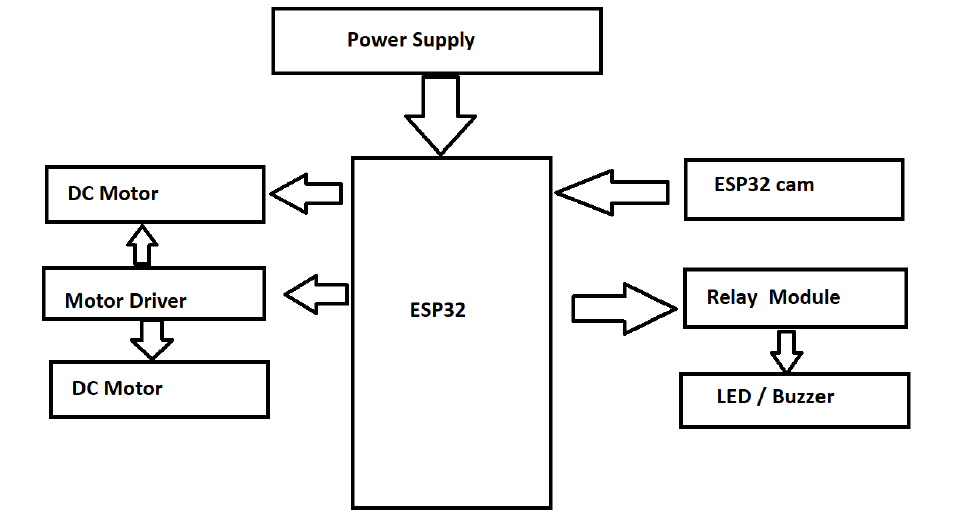
- ESP32 – Microcontroller or main processor.
- Wi-Fi / LoRa / RF Module – For remote communication.
- ESP32-CAM – For live video inspection.
- Ultrasonic / IR Sensors – For blockage and obstacle detection.
- DC Geared Motors / Crawler Tracks – For movement inside pipelines.
- Rotating Brush / Cleaning Arm – To remove blockages.
- Mini Water Pump / Sprayer – For flushing or washing the blockage.
- Battery Pack (Li-ion) – Portable power source.
- Motor Driver (L298N or similar) – To control motors.
- LED Lights – For visibility in dark areas.
Software components:
- Arduino IDE / Python (for Raspberry Pi) – To write control logic.
- Web App / Mobile App– For remote control or monitoring.
Project Description:
The Autonomous Multi-Functional Robot for Drainage Line Inspection is a smart robotic system designed to inspect underground drainage pipelines, identify blockages, and perform cleaning operations without human intervention. Traditional manual inspection of sewage pipelines is risky, time-consuming, and often ineffective due to limited visibility and unsafe working conditions. This project aims to develop a safer, more efficient, and intelligent robotic solution that automates the entire process using modern sensing, navigation, and machine-learning technologies.This robot moves through drainage pipes using rugged wheels or tracks. A camera mounted on the front gives a live feed for visual inspection. Ultrasonic or IR sensors detect blockages or bends in the pipe. If a blockage is found, the robot activates a cleaning mechanism like a rotating brush, suction pump, or water jet. It is either controlled remotely or can work autonomously using pre-set instructions. The robot can also send status alerts wirelessly.This robot provides a modern and safe solution for inspecting and cleaning drainage pipelines. It reduces health risks for workers and improves efficiency in maintenance operations. With more advanced features in the future, it can become an essential tool for smart cities and industries.

Accelerate innovation with world-class tech teams We’ll match you to an entire remote team of incredible freelance talent.